
Recognizing the Signs of Low Libido
Low libido rarely announces itself as a sudden, dramatic change. More often, it fades gradually — a slow withdrawal from desire that can be easy to rationalize away. You might tell yourself you’re just tired, or stressed, or too busy. And sometimes that’s true. But when low sexual desire persists week after week regardless of circumstances, something deeper is usually at work.
The experience of low libido varies between individuals. For some, it’s the near-complete absence of sexual interest. For others, it’s a disconnect between intellectual willingness and physical desire — the drive just isn’t there even when everything else is right. Many people describe feeling emotionally flat in ways that extend beyond sex: reduced enthusiasm, lower energy, a diminished sense of pleasure in activities that used to feel rewarding. These aren’t separate symptoms — they’re connected threads of the same hormonal picture.
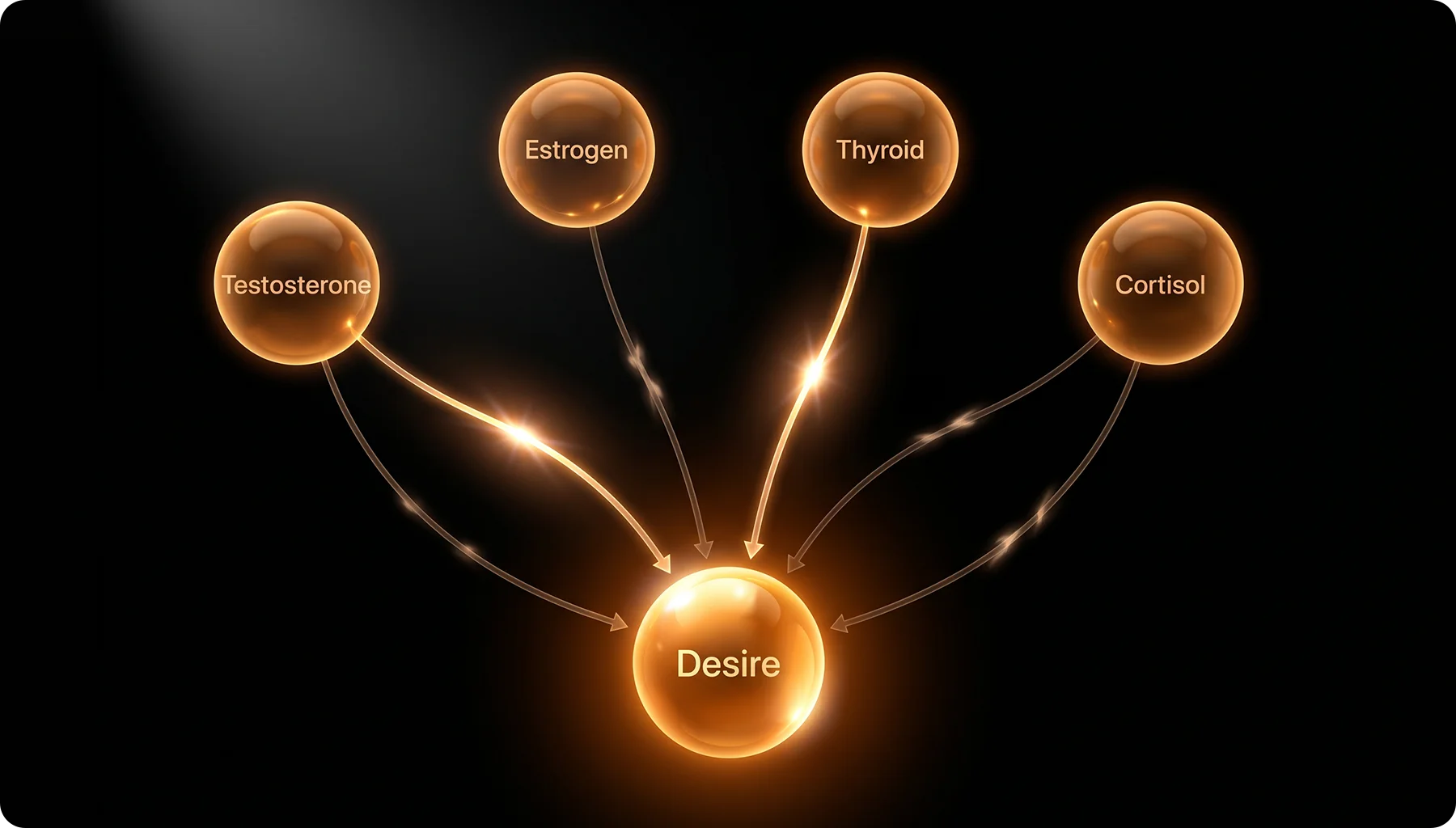
Image: Desire isn’t one signal — it’s the sum of four. Weaken any one input and the output dims.
For men, low testosterone is the most common hormonal driver of low libido — but it’s not the only one. Elevated estrogen, thyroid dysfunction, and chronic stress-related cortisol elevation all play roles. For women, the picture is often more complex: estrogen, progesterone, and testosterone all contribute to sexual desire, and the decline of any one of them — particularly during perimenopause and menopause — can significantly reduce libido.
The important thing to understand is this: low libido is not a psychological weakness. In most cases, it’s a physiological signal. And at Dynamis, we’re equipped to find out exactly what that signal is pointing to.
Benefits of Treating Low Libido
- Restored Sexual Desire and Drive
Addressing the hormonal root cause of low libido — most commonly testosterone deficiency in both men and women — directly restores sexual desire, helping you reconnect with a dimension of your life that declining hormones have been quietly suppressing. - Improved Intimacy and Relationship Satisfaction
Low libido doesn’t just affect you — it affects your relationships. Patients consistently report that restored sexual desire leads to improved intimacy, greater emotional connection, and a meaningful improvement in relationship satisfaction. - Enhanced Energy and Overall Vitality
The hormones that drive libido are the same hormones that drive energy, motivation, and mood. Restoring them addresses low desire and low vitality at the same time — because in most cases, they share the same root. - Rebuilt Confidence and Sense of Self
Libido is closely tied to identity and self-image. Patients who restore healthy sexual desire frequently describe feeling more like themselves — more confident, more engaged, and more present in their lives and relationships.
What Is Low Libido?
Libido — sexual desire — is not purely psychological. It is driven by a complex hormonal system in which testosterone plays the central role, in both men and women. Estrogen, progesterone, thyroid hormones, cortisol, and neurotransmitters all contribute to the broader environment in which desire either thrives or diminishes.
In men, testosterone is the primary hormonal driver of sex drive. Low testosterone — which affects a significant and growing portion of men, particularly over 35 — is the most direct hormonal cause of reduced libido in the male population. But elevated estradiol (which can result from testosterone converting to estrogen), thyroid dysfunction, and chronic stress all compound the picture.
In women, the hormonal drivers of libido are even more multifactorial. Testosterone — produced in small but critical amounts in the ovaries and adrenal glands — is directly responsible for sexual desire in women, yet it is routinely overlooked in standard care. Estrogen supports vaginal health, physical comfort during intimacy, and emotional engagement. Progesterone in balance supports mood and receptivity. When any one of these declines — as they naturally do with age, and more sharply during perimenopause and menopause — libido is often one of the first casualties.

Image: Desire in women is more often quiet than dramatic. When the underlying hormones are right, it returns the same way — gently, without announcement.
At Dynamis, we run a comprehensive hormone panel before any treatment recommendation. We assess testosterone (total and free), estradiol, SHBG, thyroid markers, and a full metabolic picture to identify exactly which hormonal factors are suppressing desire — and build a protocol designed to address them specifically.