
Recognizing the Signs of Muscle Loss
Muscle loss tends to be slow, quiet, and easy to overlook — until it isn’t. You notice that your strength isn’t what it was. Workouts that used to produce results now seem to yield diminishing returns. Recovery takes longer than it should. You’re eating reasonably and training consistently, but your body composition keeps shifting in the wrong direction: less muscle, more fat, less definition regardless of effort.
This progression has a name: sarcopenia. It describes the age-related loss of skeletal muscle mass and function, and research suggests it begins as early as the mid-30s — well before most people are aware it’s happening. By the time the effects become obvious, the underlying hormonal and metabolic conditions driving the loss have often been present for years.
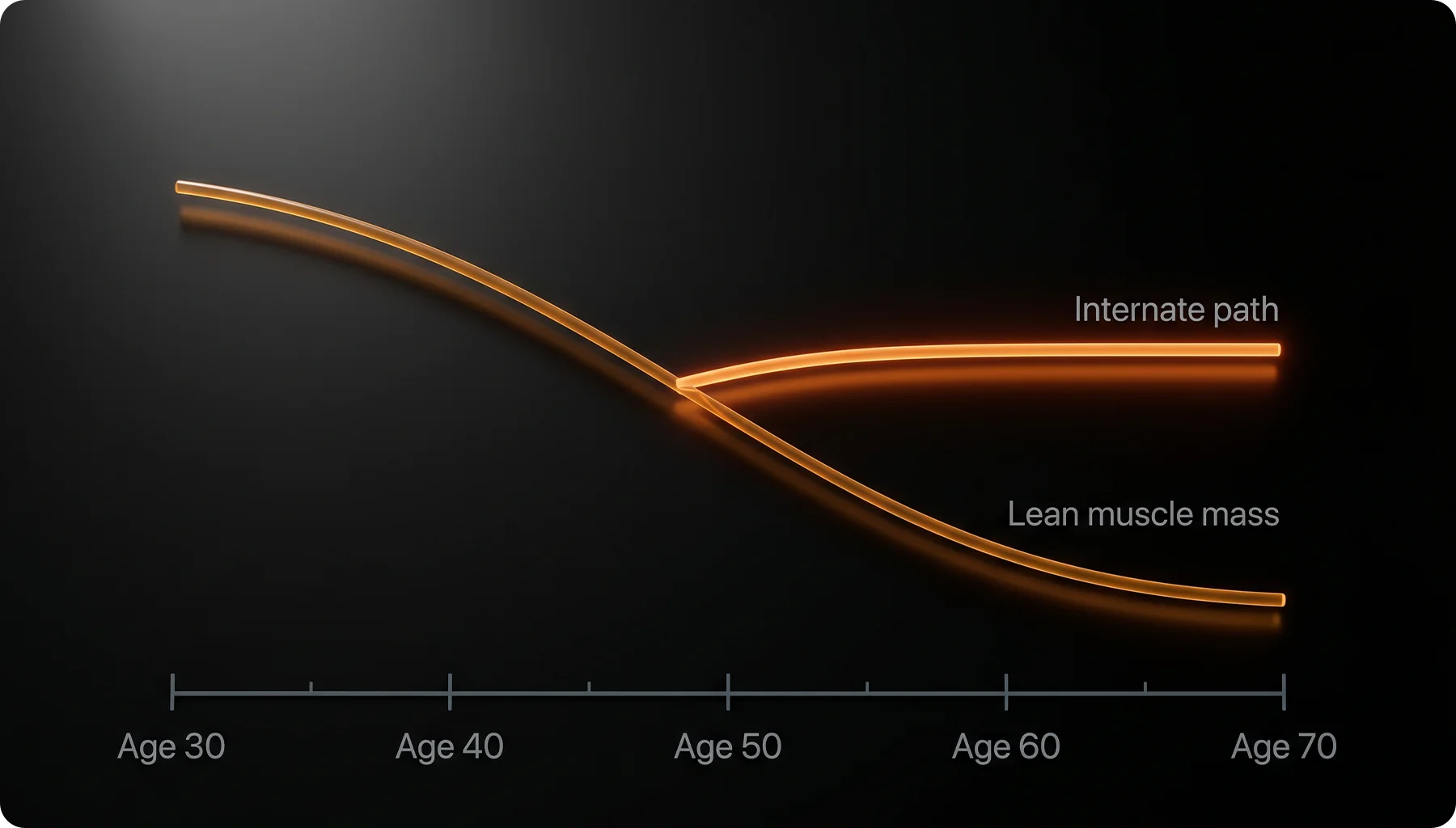
Image: Muscle loss isn’t a switch you flip in your 60s. It begins in your mid-30s and compounds. The fork in the curve is where intervention matters.
Testosterone is the primary hormonal regulator of muscle protein synthesis. When levels decline — as they do naturally with age, and more sharply in men with low T — the body’s ability to build and maintain lean mass is directly impaired. Growth hormone and IGF-1 follow a similar trajectory. For women, the hormonal shift of menopause produces a sudden acceleration of muscle loss that many find alarming and poorly explained by their standard care providers.
Beyond hormones, the metabolic environment matters. Insulin resistance impairs the body’s ability to shuttle nutrients into muscle tissue effectively. Chronic inflammation degrades muscle protein faster than it can be replaced. Poor sleep — one of the most underappreciated drivers of muscle loss — significantly impairs recovery and growth hormone release.
Benefits of Treating Muscle Loss
- Rebuilt Lean Muscle Mass and Strength
Testosterone optimization directly supports muscle protein synthesis — restoring the anabolic environment your body needs to build and maintain lean mass in response to training. Many patients see meaningful muscle and strength gains within the first few months of treatment. - Improved Body Composition and Metabolic Rate
Muscle is metabolically active tissue. Rebuilding it raises your resting metabolic rate, improves insulin sensitivity, and shifts your body composition in ways that diet and exercise alone cannot produce when hormonal conditions are working against you. - Faster Recovery and Training Response
When testosterone, growth hormone support, and peptide therapy are optimized, recovery accelerates and training produces the results it should. Patients report feeling recovered and ready to train again significantly faster than before treatment. - Long-Term Functional Health and Independence
Maintaining muscle mass as you age is one of the most powerful predictors of long-term health, independence, and quality of life. Treating muscle loss proactively at Dynamis is an investment in your functional capacity for decades to come.
What Is Muscle Loss?
Skeletal muscle is not a static tissue — it is in constant dynamic balance between synthesis (building) and breakdown. When the conditions that favor synthesis — adequate hormones, good nutrition, sufficient recovery, low inflammation — are present, muscle is maintained or built. When those conditions deteriorate, the balance tips toward breakdown, and sarcopenia progresses.
Testosterone is the primary anabolic hormone in this system. It stimulates muscle protein synthesis, supports satellite cell activity (the cellular mechanism behind muscle repair and growth), and opposes the catabolic effects of cortisol. When testosterone declines, the anabolic side of the balance weakens — and breakdown begins to outpace repair even in active, well-nourished individuals. If you’re noticing strength loss alongside fatigue, low drive, and mood changes, these may be signs of low testosterone.
Growth hormone and its downstream mediator IGF-1 play a parallel role — promoting tissue repair, fat metabolism, and the recovery processes that make training adaptations possible. These also decline with age, compounding the testosterone-related impact on body composition. Peptides that stimulate growth hormone release — such as Ipamorelin and CJC-1295 — are among the most effective tools for supporting this system.

Image: Mass holds when the underlying signals — testosterone, growth hormone, IGF-1 — hold with it. Heavy carries get easier when biology is back in your corner.
At Dynamis, we assess testosterone, free testosterone, SHBG, growth hormone markers, and a full metabolic panel before building a protocol. We look at the complete anabolic picture — not just a single hormone — because effective treatment requires understanding which specific elements of the system are out of balance.