Low Testosterone

Reclaim the energy, strength, and drive that low T has been quietly taking from you.

Low T isn’t normal aging. It’s a treatable deficiency. Falling testosterone in men and women disrupts energy, mood, body composition, sex drive, and mental clarity. At Dynamis, we build protocols around your labs, symptoms, and goals — not a one-size-fits-all dose.

Eligibility for HSA or FSA reimbursement depends on your individual plan and medical necessity. Patients are responsible for confirming eligibility with their HSA/FSA provider. A prescription or Letter of Medical Necessity may be required.

Recognizing the Signs of Low Testosterone

Low testosterone doesn’t announce itself clearly. It doesn’t arrive as a single, obvious symptom — it creeps in gradually, and it’s easy to attribute the effects to stress, aging, or just not sleeping well enough. That’s exactly why so many men go years without a diagnosis.

The picture that builds over time is recognizable, though. You wake up tired even after a full night’s sleep. The motivation that used to come naturally now requires real effort. Your workouts feel harder, your recovery takes longer, and the muscle you used to build and maintain seems to be disappearing despite your best efforts. Your weight shifts — particularly around the midsection — without any obvious change in diet. Your mood becomes harder to regulate: irritability, low-grade anxiety, or a flat emotional baseline that doesn’t feel like you.

Then there’s the mental side. Brain fog. The inability to focus, retain information, or think as sharply as you once did. It’s one of the most common and least-discussed symptoms of low T. So is reduced libido, and for many men, changes in sexual function that affect confidence and relationships. These aren’t character flaws or inevitable signs of aging. They’re physiological signals that something in your hormone system is out of range.

Testosterone levels naturally decline with age – roughly 1-2% per year after 30, but declining isn’t the same as optimal. At Dynamis, we don’t treat your labs in isolation. We treat the full picture: your numbers, your symptoms, and your quality of life.


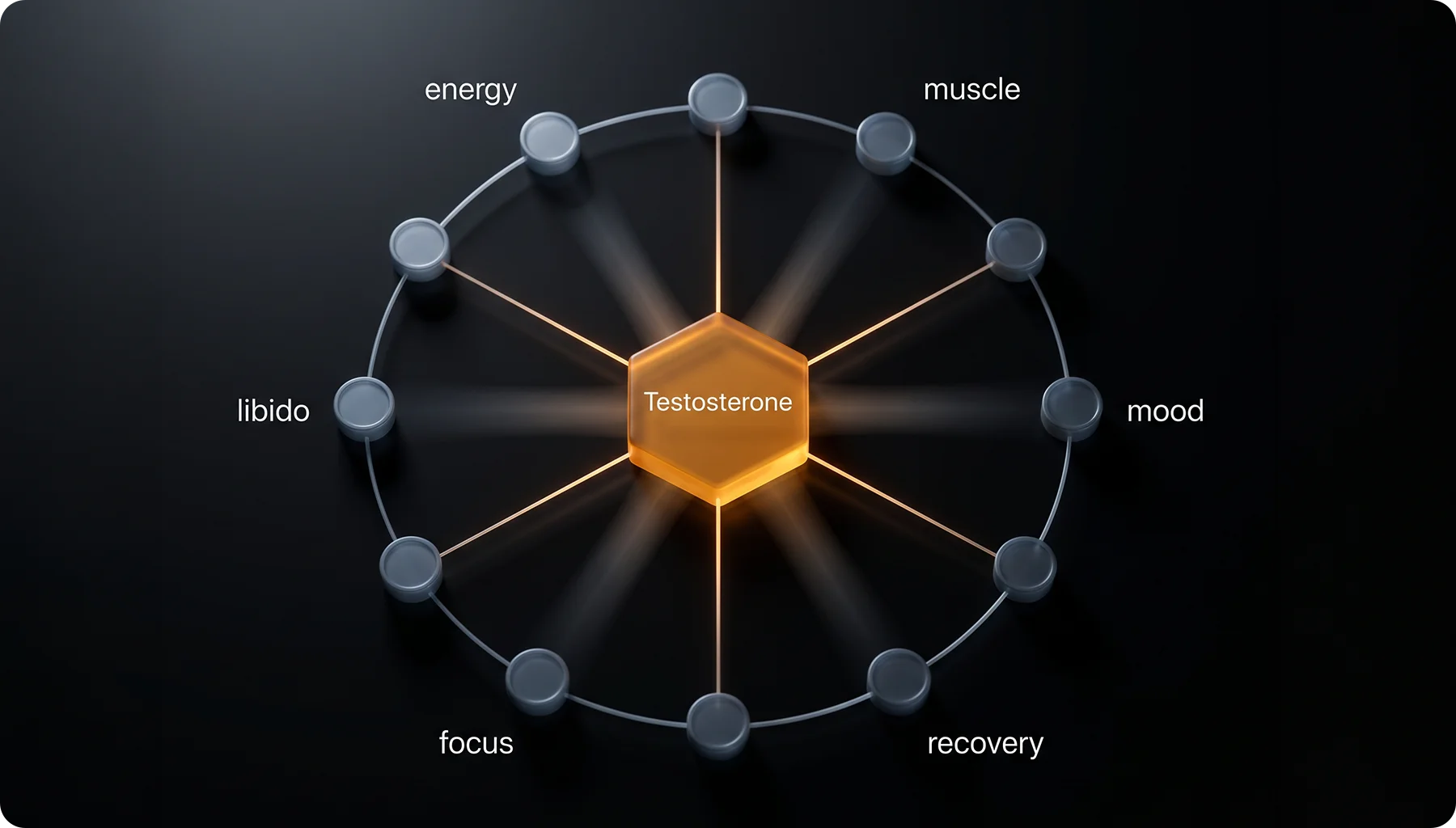
Image: One hormone. Six systems. When testosterone drops, the cost doesn’t stay in one place.

Benefits of Treating Low Testosterone

  1. Restored Energy and Mental Clarity
    Optimizing testosterone levels addresses fatigue at its hormonal root, restoring the sustained energy and mental sharpness that low T gradually erodes — without relying on stimulants or workarounds.
  2. Improved Body Composition and Strength
    Testosterone plays a central role in how your body builds muscle and manages fat. Restoring optimal levels helps you respond to training again, rebuild lean mass, and reduce the stubborn fat accumulation that low T promotes.
  3. Enhanced Libido and Sexual Function
    Testosterone is the primary driver of sex drive in both men and women. Treatment helps restore healthy libido, improve sexual function, and rebuild the confidence that often suffers when these areas decline.
  4. Stabilized Mood and Emotional Resilience
    Low testosterone has a direct impact on mood regulation, motivation, and stress response. Patients consistently report feeling more like themselves — steadier, more driven, and more engaged in their lives — once their levels are optimized.

What Is Low Testosterone?

Testosterone is the primary androgen hormone in the human body — essential not just for sexual function and muscle development, but for energy metabolism, cognitive function, bone density, cardiovascular health, and emotional regulation. In men, it’s produced primarily in the testes. In women, it’s produced in the ovaries and adrenal glands in smaller but equally important amounts.


Image: One hormone. Six systems. When testosterone drops, the cost doesn’t stay in one place.

Low testosterone — clinically referred to as hypogonadism in men — is diagnosed when total testosterone falls below a threshold that impairs normal function. But here’s where conventional medicine often falls short: standard lab reference ranges are built on population averages, not optimal health. A result that reads “within normal limits” can still represent a level that leaves you feeling chronically below your best.

At Dynamis, we look beyond the standard reference range. We assess total testosterone, free testosterone, SHBG, LH, FSH, estradiol, and a full metabolic panel to understand not just where your numbers land — but why, and what they mean for how you feel and function every day.

Low testosterone can be primary (originating in the testes or ovaries) or secondary (driven by signaling failures in the pituitary or hypothalamus). It can be caused by aging, chronic stress, poor sleep, obesity, certain medications, or underlying medical conditions. Understanding the cause matters because it shapes the treatment — and at Dynamis, we’re built for that level of nuance.


Awaken the Warrior from within

Call (469) 214-3404 or fill out the form, and our team will reach out to you right away.

Low Testosterone At a Glance

Common Symptoms

Declining energy, reduced strength and muscle mass, cognitive changes, weight gain, reduced libido, slower recovery, changes in skin and appearance, reduced resilience to stress and illness

Treatment Approach

Comprehensive hormone optimization, peptide therapy, metabolic support, and health coaching

Typical Protocol Duration

Ongoing, with reassessment every 90 days

Getting Started

Free online assessment + comprehensive longevity-focused lab panel

Dynamis is a proud Member of the Tele-Health Association.
Awaken the Warrior from within

Call (469) 214-3404 or fill out the form, and our team will reach out to you right away.

How Dynamis Treats Low Testosterone

Step 1
Free Assessment

You complete a short health questionnaire online covering your symptoms, health history, and goals. No cost, no commitment — just a clear first step.

Step 2
Comprehensive Lab Work

We coordinate a full hormone panel through a partner lab near you — testing not just testosterone, but the full hormonal picture needed to build an accurate protocol.

Step 3
Personalized Protocol

A board-certified provider reviews your labs and meets with you via telehealth to design a protocol specific to your body, your levels, and your goals.

Step 4
Ongoing Monitoring and Coaching

Low testosterone treatment isn’t a one-time fix. Your provider tracks your progress with follow-up labs and consultations every 90 days, and your health coach supports you between visits — adjusting your protocol as your body responds.


Treatment Options for Low Testosterone at Dynamis

At Dynamis, no two protocols are identical. Your provider selects from a range of evidence-based treatments based on your lab work, your symptoms, and your goals. Here’s what that may include:

Testosterone Replacement Therapy (TRT)

The cornerstone of most low testosterone protocols. TRT restores testosterone to optimal levels through injections, gels, or other delivery methods. Your provider determines the right form, dose, and schedule based on your individual lab results and lifestyle.

Gonadorelin

For men who want to maintain natural testicular function while on TRT, Gonadorelin is a peptide that mimics gonadotropin-releasing hormone — stimulating the body’s own testosterone production pathway and supporting fertility preservation during treatment.

Enclomiphene / Clomiphene

A non-TRT option for men whose bodies still have production capacity. These selective estrogen receptor modulators (SERMs) stimulate the pituitary to produce more LH and FSH, which in turn signals the testes to increase testosterone output — without introducing exogenous testosterone.

Estrogen Management

Testosterone and estrogen exist in balance. As testosterone rises, some converts to estradiol. Your Dynamis provider monitors this carefully and may include an aromatase inhibitor or estrogen modulator to keep your levels in an optimal ratio.

Health Coaching

Every Dynamis patient is supported by a health coach who works alongside your medical provider. Sleep, nutrition, stress management, and training all have direct effects on testosterone — your coach helps you optimize these factors to compound the results of your protocol.

Frequently Asked Questions

Testosterone levels decline naturally with age, but the drop can be accelerated by chronic stress, poor sleep, obesity, a sedentary lifestyle, certain medications, and underlying conditions affecting the pituitary or hypothalamus. In some cases, the cause is primary – originating in the testes themselves. Identifying the cause is part of how Dynamis builds your protocol.

Diagnosis requires a blood test measuring total testosterone, and ideally free testosterone and SHBG. At Dynamis, we go further – running a comprehensive panel that includes LH, FSH, estradiol, thyroid markers, and metabolic indicators to get a complete hormonal picture before recommending any treatment.

Standard lab reference ranges reflect population averages – not optimal health. A level of 300 ng/dL is technically “normal” by most lab standards, but many men feel significantly better when levels are optimized to the 700-900 ng/dL range. At Dynamis, we treat your symptoms and your goals, not just your number on a reference chart.

Most patients begin noticing improvements in energy, mood, and sleep within 3-6 weeks of starting treatment. Body composition changes and full symptomatic improvement typically develop over 3-6 months as levels stabilize and your body adapts to the protocol.

When properly monitored, TRT has a strong long-term safety profile. Regular lab work is essential – which is why Dynamis builds follow-up testing into every protocol. Your provider monitors testosterone, estradiol, hematocrit, PSA, and other key markers at each check-in to ensure you remain in a healthy range.

Our Five Stars

From one warrior to another

We’re proud of the results our patients achieve and the trust they place in our team. Read our reviews below to see why men and women across the country choose Dynamis for hormone therapy and medical weight loss.

Dynamis Online

Phone: (469) 214-3404

Hours: Mon-Fri 9AM-4PM