
Thyroid Problems

Your thyroid controls more than most people realize - and "normal" isn't always good enough.

Thyroid health isn’t one number. It’s a system. The thyroid regulates metabolism, energy, weight, cognition, mood, temperature, hair, skin, and heart rate. At Dynamis, we run a comprehensive panel and build personalized protocols around your physiology — not a population average.

Eligibility for HSA or FSA reimbursement depends on your individual plan and medical necessity. Patients are responsible for confirming eligibility with their HSA/FSA provider. A prescription or Letter of Medical Necessity may be required.

Recognizing the Signs of Thyroid Problems

Thyroid dysfunction is one of the great mimics of medicine — its symptoms overlap with depression, chronic fatigue, anxiety, menopause, and dozens of other conditions, which is part of why it’s so commonly missed or misdiagnosed. Hypothyroidism (underactive thyroid) and hyperthyroidism (overactive thyroid) produce largely opposite symptom profiles, but both can be subtle in their early stages and easy to attribute to other causes.

With hypothyroidism — by far the more common condition — the symptoms reflect a metabolism that has slowed down across the board. Persistent fatigue that doesn’t resolve with rest. Weight that accumulates and resists loss despite diet and exercise. Cognitive slowing — the brain fog that makes thinking feel effortful and dull. Cold intolerance — feeling colder than the people around you, particularly in the hands and feet. Hair thinning and loss, dry skin, constipation, and a general low-grade heaviness to daily function that can feel like depression but may have a simpler physiological explanation.
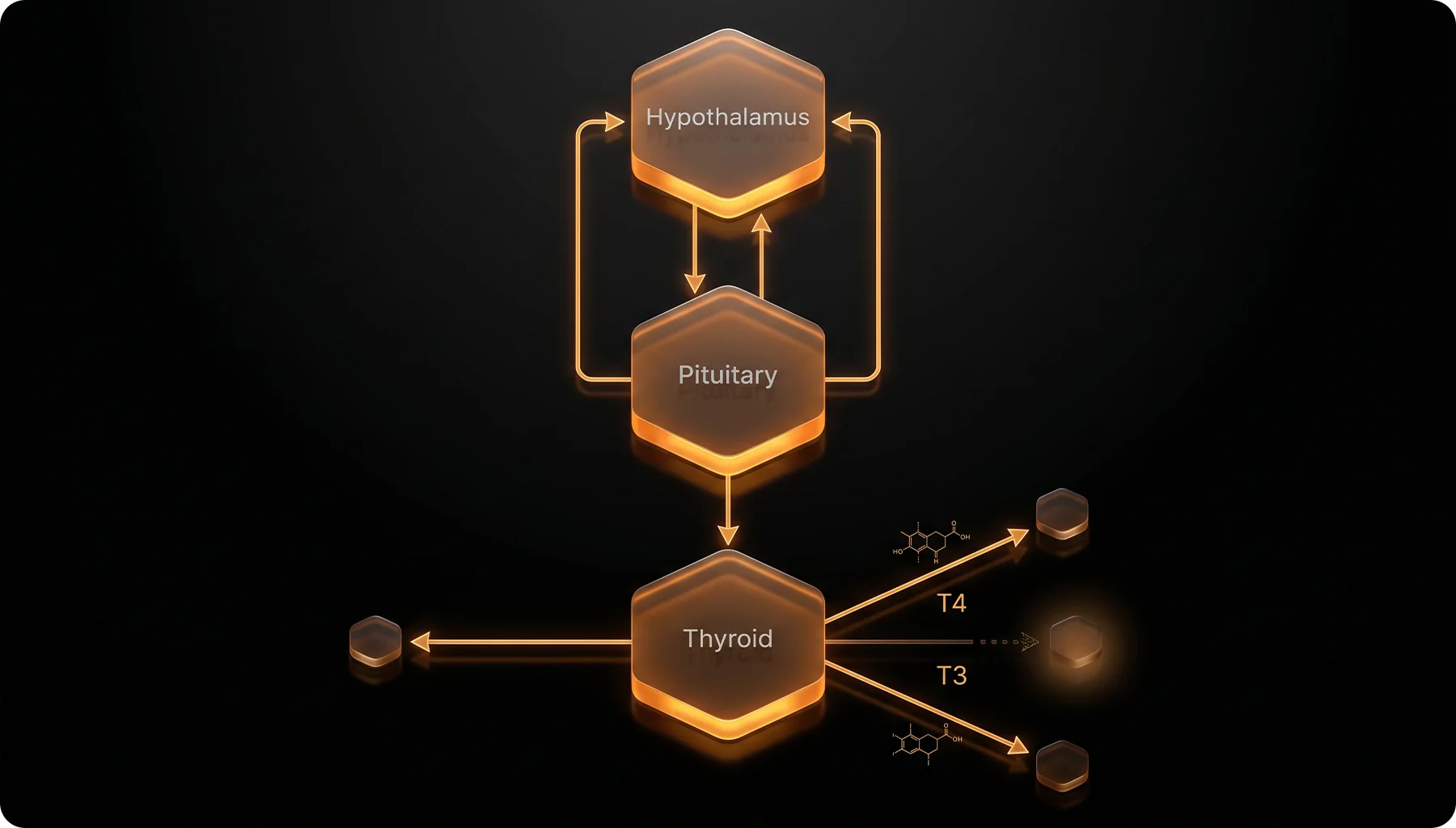

Image: Thyroid function isn’t one number. It’s an axis of signals — and TSH-only testing reads only the first link.

Hashimoto’s thyroiditis — an autoimmune condition in which the immune system attacks the thyroid gland — is the most common cause of hypothyroidism in the developed world, and it is frequently not tested for in standard care. Patients with Hashimoto’s often experience fluctuating symptoms and can test within normal TSH range even while their thyroid function is meaningfully compromised.

The problem with conventional thyroid care is often the testing itself. Relying on TSH alone — as most standard panels do — misses the full picture. Free T3 (the active thyroid hormone) and free T4 (the precursor) must both be measured to understand how well the thyroid is actually functioning. And thyroid antibodies (TPO and TgAb) are essential for identifying autoimmune involvement.

Benefits of Treating Thyroid Problems

  1. Restored Energy and Metabolic Function
    Optimizing thyroid hormone levels restores the metabolic rate that suboptimal thyroid function has suppressed — producing significant improvements in energy, stamina, and the ability to function at full capacity.
  2. Clearer Cognition and Better Mood
    Thyroid hormone directly supports neurological function and neurotransmitter balance. Treating hypothyroidism often produces meaningful improvements in brain fog, mood, and motivation that patients sometimes mistake for antidepressant effects.
  3. Improved Weight Management
    Thyroid dysfunction is one of the most common hormonal drivers of weight gain that resists conventional interventions. Restoring optimal thyroid function improves metabolism and makes the body significantly more responsive to diet and exercise.
  4. Healthier Hair, Skin, and Overall Physiological Function
    Many of the cosmetic and physical symptoms of thyroid dysfunction — hair loss, dry skin, brittle nails, sluggish digestion — improve meaningfully when thyroid levels are properly optimized, reflecting the gland’s central role in whole-body physiology.


What Is Thyroid Disease?

The thyroid gland — a small, butterfly-shaped gland at the base of the neck — produces two primary hormones: thyroxine (T4) and triiodothyronine (T3). T4 is produced in large quantities and converted to the more biologically active T3 in peripheral tissues. These hormones regulate the metabolic rate of virtually every cell and tissue in the body, influencing energy production, protein synthesis, temperature regulation, heart rate, and the function of the digestive, nervous, and reproductive systems.

Hypothyroidism — the underproduction of thyroid hormone — is estimated to affect 20 million Americans, with many more undiagnosed. The most common cause is Hashimoto’s thyroiditis, an autoimmune condition that gradually destroys thyroid tissue. Primary hypothyroidism (where the thyroid itself is underperforming) is more common than secondary hypothyroidism (where the pituitary fails to adequately stimulate the thyroid), but both require different treatment approaches.


Image: Comfortable in cold air is what restored thyroid function looks like. Metabolism makes its own heat — when conversion actually happens.

Subclinical hypothyroidism — where TSH is mildly elevated but T4 and T3 remain technically within normal range — is a particularly contested area. Many patients with subclinical hypothyroidism experience significant symptoms and respond well to treatment, yet are often told their thyroid is “normal” and sent home without intervention. This is exactly the gap Dynamis is designed to fill.

At Dynamis, we test TSH, free T3, free T4, reverse T3, TPO antibodies, and TgAb antibodies — giving us a complete functional picture of your thyroid health, not just a single number.


Awaken the Warrior from within

Call (469) 214-3404 or fill out the form, and our team will reach out to you right away.

Thyroid Problems At a Glance

Common Symptoms

Fatigue, weight gain, brain fog, depression, cold intolerance, hair loss, dry skin, constipation (hypothyroidism) or anxiety, weight loss, heat intolerance, rapid heartbeat (hyperthyroidism)

Treatment Approach

Comprehensive thyroid testing, personalized thyroid hormone therapy, and health coaching

Typical Protocol Duration

Ongoing, with reassessment every 90 days

Getting Started

Free online assessment + comprehensive thyroid and hormone panel

Dynamis is a proud Member of the Tele-Health Association.
Awaken the Warrior from within

Call (469) 214-3404 or fill out the form, and our team will reach out to you right away.

How Dynamis Treats Thyroid Problems


Step 1
Free Assessment

You complete a short health questionnaire covering your symptoms, health history, and goals. No cost, no commitment.

Step 2
Comprehensive Thyroid Panel

We coordinate lab work that includes TSH, free T3, free T4, reverse T3, and thyroid antibodies — the complete picture that standard care typically doesn’t order.

Step 3
Personalized Protocol

A board-certified provider reviews your labs and meets with you via telehealth to design a thyroid treatment protocol appropriate to your specific results, symptom profile, and overall hormone picture.

Step 4
Ongoing Monitoring

Thyroid treatment requires ongoing monitoring and adjustment. Your provider tracks your labs and adjusts your protocol at regular intervals. Your health coach supports lifestyle optimization between visits.


Treatment Options for Thyroid Problems at Dynamis


Image: Quiet mornings without dread are a thyroid signal. When conversion works, energy doesn’t have to be summoned — it’s already there.

Levothyroxine (T4 Therapy)

The most commonly prescribed thyroid medication, levothyroxine replaces T4 — which the body then converts to the active T3. It is appropriate for many patients with hypothyroidism and provides stable, predictable hormone levels when dosed correctly.

Combination T4/T3 Therapy (Liothyronine)

Some patients don’t convert T4 to T3 efficiently, and benefit from a protocol that includes direct T3 supplementation alongside T4. Dynamis providers are comfortable prescribing combination therapy where your lab results and symptom response indicate it’s the right approach.

Desiccated Thyroid Extract (DTE)

A naturally derived thyroid hormone containing both T4 and T3 in their natural ratio. Some patients prefer DTE and respond better to it than to synthetic alternatives. Dynamis includes this as an option where clinically appropriate and patient-preferred.

Hashimoto’s and Autoimmune Support

For patients with Hashimoto’s thyroiditis, managing the autoimmune component — through lifestyle modification, nutritional support, and monitoring of antibody levels — is part of comprehensive care alongside hormone replacement.

Health Coaching

Nutritional factors (selenium, iodine, zinc), stress management, sleep quality, and gut health all directly affect thyroid function and the conversion of T4 to T3. Your Dynamis health coach works with you to optimize these variables alongside your medical protocol.

Frequently Asked Questions

Hypothyroidism is an underactive thyroid – producing too little hormone, slowing metabolism, and causing fatigue, weight gain, brain fog, and cold intolerance. Hyperthyroidism is an overactive thyroid – producing too much hormone, accelerating metabolism, and causing anxiety, weight loss, heat intolerance, and rapid heartbeat. Both are diagnosable and treatable with the right evaluation.

Most standard thyroid panels only test TSH. A TSH within reference range does not mean your thyroid is functioning optimally – it simply means the pituitary signal is within a broad population average. Without measuring free T3, free T4, and antibodies, critical information is missing. Dynamis tests the complete picture.

Hashimoto’s is an autoimmune condition in which the immune system produces antibodies that attack the thyroid gland, gradually impairing its function. It is the most common cause of hypothyroidism. Many patients with Hashimoto’s are not diagnosed until significant thyroid damage has occurred – because antibody testing is not part of standard TSH panels.

Subclinical hypothyroidism is a condition in which TSH is mildly elevated but T4 levels remain technically within range. Many patients with subclinical hypothyroidism experience significant symptoms. Whether to treat is a clinical judgment based on symptoms, antibody status, and individual health goals – and at Dynamis, we make that judgment with you, not for you.

Many patients notice improvements in energy and mood within 2-4 weeks of starting thyroid therapy. Full symptom resolution typically takes 2-3 months as levels stabilize. Some fine-tuning of dose is expected in the early months of treatment.

Our Five Stars

From one warrior to another

We’re proud of the results our patients achieve and the trust they place in our team. Read our reviews below to see why men and women across the country choose Dynamis for hormone therapy and medical weight loss.

Dynamis Online

Phone: (469) 214-3404

Hours: Mon-Fri 9AM-4PM