
Recognizing the Signs of Accelerated Aging
Aging manifests differently for different people — but the underlying hormonal and metabolic processes that drive it follow a recognizable trajectory. Testosterone and growth hormone begin declining in the 30s. Estrogen and progesterone shift dramatically in women’s 40s and 50s. Thyroid function becomes less efficient. Insulin sensitivity decreases. Inflammatory markers trend upward. Cellular repair mechanisms slow. Taken together, these changes produce the constellation of symptoms most people associate with “just getting older.”
The energy that used to come naturally requires increasing effort to manufacture. Recovery from physical exertion takes longer — workouts that once left you tired but satisfied now leave you depleted for days. Lean muscle mass quietly erodes despite training. Sleep becomes lighter and less restorative. Cognitive performance — memory, processing speed, word retrieval — begins to show subtle but noticeable changes. Skin thins. Hair changes. The physiological resilience that made it easy to bounce back from illness, stress, or a bad week diminishes.
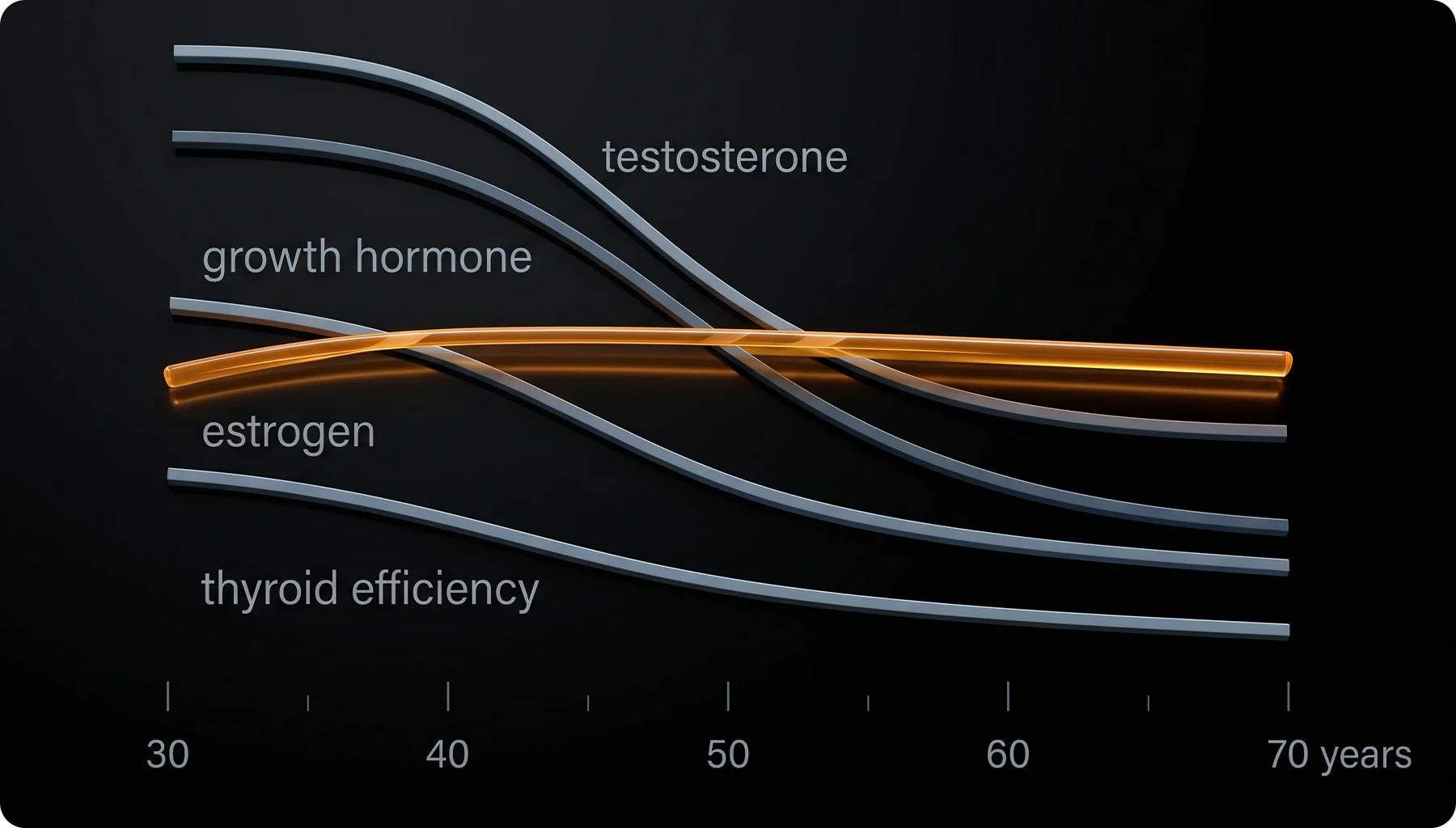
Image: Aging is the sum of slopes, not a single decline. The intervention curve is the difference between adding years and adding life.
None of these changes are sudden — they compound gradually, and they’re easy to attribute to life circumstances rather than to the measurable hormonal and metabolic shifts that are driving them. This is the gap Dynamis is built to address: the space between “within normal limits” on a standard lab panel and actually feeling your best.
The good news is that many of the most significant drivers of accelerated aging are addressable. The hormonal decline that underlies so many of these changes is not a fixed fate — it’s a measurable physiological state with effective interventions. The metabolic deterioration that drives inflammation and cellular dysfunction can be reversed with the right protocol. And the earlier you engage with this process, the more runway you have to optimize.
Benefits of an Anti-Aging Protocol at Dynamis
- Preserved Energy, Drive, and Physical Vitality
Hormonal optimization — particularly testosterone, growth hormone support, and thyroid function — directly addresses the energy depletion, reduced drive, and physical decline that accelerating hormonal change produces. Patients describe feeling years younger in terms of energy and daily vitality. - Maintained Muscle Mass, Strength, and Body Composition
The loss of lean muscle mass with age (sarcopenia) is one of the most consequential physical changes of aging — affecting metabolism, mobility, strength, and long-term independence. Dynamis protocols are specifically designed to slow and reverse this process. - Sharper Cognition and Mental Performance
The cognitive changes of aging — slower processing, reduced recall, declining focus — are significantly influenced by hormonal status. Optimizing testosterone, thyroid, and other cognitive-support pathways helps maintain the mental performance that aging would otherwise gradually erode. - Longer Health Span, Not Just Life Span
The goal of aging well isn’t just living longer — it’s maintaining quality of life, physical independence, and cognitive function for as many of those years as possible. Dynamis protocols are designed with health span in mind: building and preserving the physical and mental capacity that makes a long life worth living.
What Drives Biological Aging?
Biological aging — as distinct from the simple passage of time — is driven by a set of interconnected processes that include hormonal decline, mitochondrial dysfunction, chronic low-grade inflammation (sometimes called “inflammaging”), reduced cellular repair capacity, oxidative stress, and progressive metabolic dysfunction. Understanding which of these processes is most advanced in any individual is the starting point for meaningful anti-aging intervention.
The hormonal dimension is the most directly addressable. Testosterone, estrogen, progesterone, DHEA, growth hormone, and thyroid hormone all decline with age — and each decline carries its own downstream effects on body composition, cognition, energy, cardiovascular health, and bone density. Replacing and optimizing these hormones where deficiency exists is the foundation of a clinical anti-aging strategy.
Mitochondrial health — the efficiency of cellular energy production — is a key determinant of how you feel and function at the cellular level. NAD+ is a coenzyme central to mitochondrial function that declines significantly with age, and NAD+ supplementation has become one of the more studied interventions in the longevity space. Peptides like BPC-157, Ipamorelin, and others support tissue repair, growth hormone release, and regenerative capacity that decline with age.

Image: Resilience is biological. Restore the underlying systems and your 50s can be a peak, not a managed decline.
Chronic low-grade inflammation is the biological environment in which age-related diseases develop. Metabolic health — insulin sensitivity, body composition, cardiovascular markers — both reflects and shapes inflammatory status. A Dynamis anti-aging protocol addresses all of these systems together — because optimizing one in isolation produces far less than addressing the full picture.